
What if you could buy the same income stream in any location, but some areas have less pressure from expenses than others?
Or does it make sense to purchase a newer building that has a much lower expense ratio but you have to pay more for it?
Tim was an investor who definitely learned this in practice. Initially Tim started out buying B and C class buildings that needed a lot of renovation and was a heavy value-add investor. But over time Tim realized that the burden of ongoing expenses began to outweigh the higher cash flow with his older buildings.
He started trading up into Class A properties and even though they are much more expensive to purchase, the lower expense ratio typically netted him more at the bottom line.
For multifamily investors, the operating expense ratio (OER) is one of the most powerful single numbers on a deal. It tells you what share of gross income is consumed by the cost of running the property—before debt service—and it is the lever that quietly separates a great market from a punishing one. Two buildings with identical rent rolls can produce very different cash flows once expenses are layered in, and those expenses are largely a function of where the property sits or the age of the building.
What the Expense Ratio Actually Measures
The operating expense ratio is calculated as total operating expenses divided by effective gross income (EGI). Operating expenses include:
- Property taxes
- Insurance
- Utilities (where owner-paid)
- Repairs and maintenance
- Payroll for on-site staff & management fees
- Marketing
- Turnover costs
- It excludes capital expenditures, mortgage payments, and owner income taxes—those live further down the income statement.
Across stabilized U.S. multifamily, OERs commonly fall between 35% and 55%. Class A new construction in a low-tax Sun Belt market may run in the mid-30s, while a 1920s Mid-rise in the Northeast can easily push past 60%. Underwriting a property with a market-blind 40% assumption is one of the fastest ways to overpay or lose out on deals from too conservative underwriting.
Why Metro Area Drives So Much Variance
Most line items on a multifamily P&L are local. Five categories explain the bulk of the geographic spread:
Property taxes
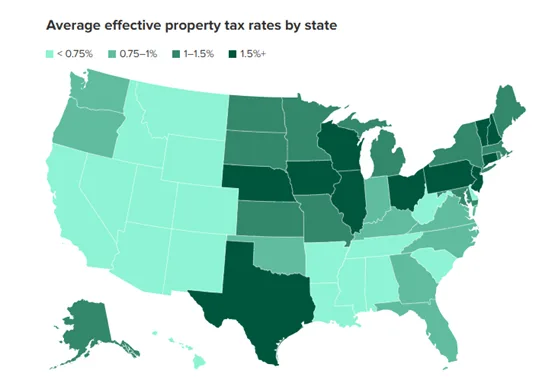
The single largest swing factor. Effective rates in Illinois, New Jersey, Texas, and parts of New York can exceed 2% of assessed value, while Arizona, Nevada, and Colorado often sit below 0.7%. Reassessment rules also matter—some states reset to market on sale, instantly inflating year-one expenses.
Pennsylvania sits at 1.26% while Maryland is .92% of value, on average. Because PA does not reassess a new value at the time of sale, the property taxes are typically higher on newer units than much older ones, because newer have a more recent value assessment.
Insurance
Coastal Florida, the Gulf Coast, and California have seen premiums double or triple since 2020 due to hurricane, wildfire, and flood exposure. In some Florida submarkets, insurance alone now equals 15% to 20% of gross rents.
The good news is that insurance costs for newer buildings are generally lower, as newer buildings have more fire and disaster proof materials, higher quality tenants and modern safety standards.
Labor and maintenance
Union markets (NYC, Chicago, San Francisco) carry materially higher payroll for qualified contractors. HVAC techs and plumbers in coastal metros bill 50% to 100% more per hour than in the Midwest.
Areas with higher minimum wage requirements will generally have higher overall labor cost as a result.
Utilities
While most landlords have a goal to add utilities to the tenant expense side, where they do pay for utilities, location has a tremendous bearing on those costs. Cold-climate markets pay for heat; hot, arid markets pay for cooling and water. California and the Northeast also carry higher per-kWh electricity costs.
Even locally in the Northeast, the cost for items like sewer and water expense can vary significantly based on whether a public or private utility provides the service. The water costs can be twice as high in one Boro than the neighboring municipality, based on their cost to supply and efficiencies.
Regulation
Rent stabilization, eviction moratoriums, lead and mold compliance, and local registration fees all add overhead—costs that rarely show up cleanly in a pro-forma but compress the OER in practice.
Understanding the local level requirements for inspections and building monitoring can make a pretty significant difference in the ongoing maintenance cost for property owners.
Locally, many municipalities are enacting lead-based inspections for both lead pipes and paint and ensuring compliance for older multi-family properties can be a fairly significant expense.
How OERs Stack Up Across Major Metros
The table below shows representative stabilized OER ranges for institutional-quality multifamily across selected U.S. metros. Actual results vary by vintage, class, and management quality, but the relative ordering is durable.
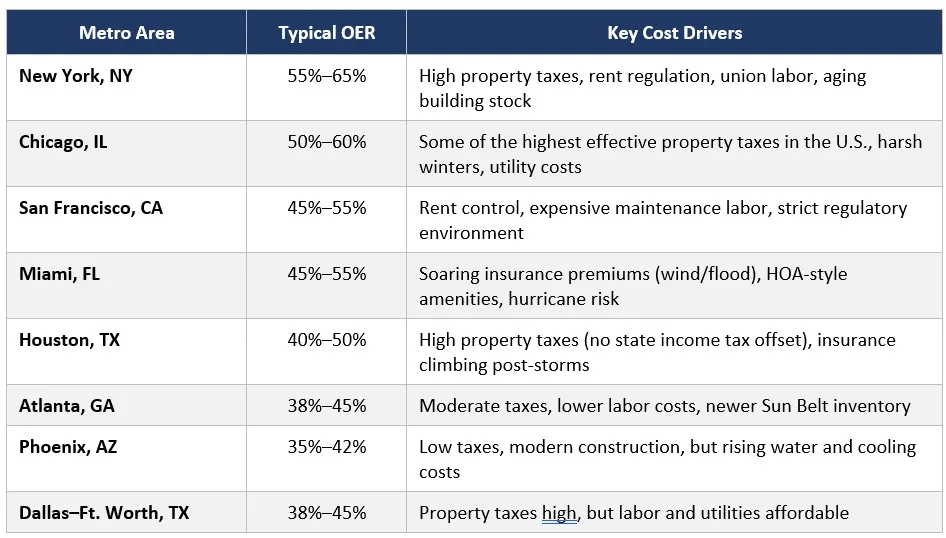
The pattern is consistent: legacy gateway cities and high-tax Midwestern markets cluster at the top, while newer Sun Belt metros with lighter tax burdens and modern building stock sit at the bottom. Florida is the wild card—historically a low-OER market, it has migrated upward almost entirely on the back of insurance.
What This Means for Underwriting
A disciplined investor underwrites expenses bottom-up by line item rather than applying a generic ratio. That means pulling the actual property tax bill (and modeling the post-sale reassessment if applicable), getting at least two insurance quotes for the specific building, benchmarking payroll against comparable assets in the submarket, and stress-testing utility costs against a five-year historical envelope rather than the trailing twelve months.
Equally important: the OER is not static. Insurance renewals, tax reassessments, and minimum-wage changes can move the ratio 300 to 500 basis points in a single year, especially in Florida, Texas, and California.
The Bottom Line
A 45% expense ratio in Phoenix and a 45% expense ratio in Philadelphia describe two very different deals—one is at the top of its market’s range, the other may be in Mid-range.
Knowing where each metro typically lands, and which class of building receiving the input, is the difference between underwriting that holds up and underwriting that surprises you in year two.
For Tim, having less surprises meant he purchased in lower volatility markets, and prefers newer built properties to simplify the expenses. This simplifies the return, and provides less potential for that NOI to be subject to pressures.
If you are an investor who is looking to make more calculated and informed decisions, then you are in the right place! Contact us for a strategy call, and benefit from how we can enhance your investments and ensure they have a solid base for long term cash flow growth.