by Ida McMurray, CCIM, SIOR
Preventative maintenance is a strategic imperative—but it delivers its greatest dividends when it is directed by skilled property managers who couple building knowledge with financial guidance. By incorporating proactive maintenance in a formal management program, owners create safe, efficient, and market-leading assets that outperform peers and build a legacy of quality and profitability.
Increasing Property Value – Guided by Management Expertise
A well-maintained building commands higher appraisals and attracts credit-worthy tenants, yet that outcome rarely happens by chance. Experienced property managers:
- Plan capital and cosmetic projects (landscaping, facade cleaning, repainting) on multiyear cycles so curb appeal never fades.
- Document every repair and upgrade in cloud-based maintenance software, giving buyers and appraisers indisputable proof of maintenance.
- Leverage tenant-experience tools (online work-order apps) that keep occupants comfortable and eager to renew, lifting net operating income and, in turn, asset value.
Cost Efficiency and Lifecycle Savings – Preparing the Management Team
Emergency repairs can cost three to five times more than scheduled work, especially if after-hours labor or tenant disruption is involved. Property managers reduce that volatility by:
- Building predictive maintenance calendars that extend HVAC, roof, plumbing, and electrical life cycles.
- Negotiating portfolio-level service contracts that lock in volume pricing for filter changes, routine maintenance services and code compliance inspections. Some landlords offer incentives to tenants that can assist in some simple maintenance, such as changing air filters and notification of issues early.
- Running energy-management analytics to spot consumption spikes early – cutting utility costs.
Routine Inspections: The Foundation of Preventative Maintenance
Inspections catch minor issues before they escalate, but their frequency and depth improve dramatically under professional management:
- Monthly or quarterly in-house rounds to note wear, leaks, and safety hazards.
- Seasonal drone or thermal-camera surveys reveal hidden roof damage or electrical hotspots
- Annual third-party condition assessments (structural, MEP, life-safety) feed long-range reserve studies, keeping replacement reserves realistic and audit-ready.
Insurance Advantages: Risk Mitigation Through Management Discipline
Insurers reward low-risk properties; property managers make that status possible. Comprehensive digital records of inspections, permits, and vendor certifications demonstrate diligence, lowering premiums and smoothing claims. Managers also conduct coverage audits each renewal cycle, ensuring the policy evolves with the building and its tenants.
How to Compare Insurance Effectively – with a Manager at the Table
Policy selection is more than price shopping. Property managers can:
- Create a risk matrix that weights deductibles, sublimits, and exclusions against probable loss scenarios.
- Benchmark carriers’ claims-handling speed – knowledge gained from managing multiple assets.
- Coordinate bundled policies (property, liability, business interruption) to capture aggregate discounts without sacrificing coverage depth.
The Strategic Role of Professional Property Management
Beyond maintenance, modern managers act as:
- Data translators, turning sensor readings and work-order metrics into budgeting intelligence.
- Tenant educators, teaching occupants how to minimize wear and promptly report issues.
- Capital advisors, sequencing upgrades (LED retrofits, BAS integrations) for maximum ROI and tax efficiency.
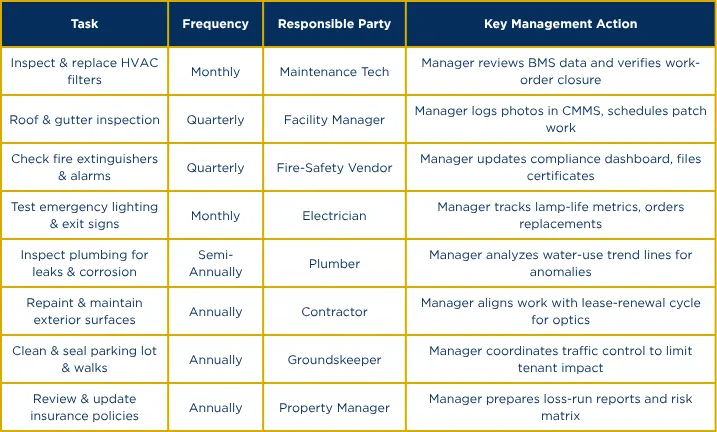
Sample Preventative Maintenance Checklist
Conclusion
Preventative maintenance delivers the best return when coupled with professional property management that treats every inspection, service ticket, and policy renewal as an asset-wide comprehensive loop. Owners who invest in this partnership spend less on surprises, insure on better terms, and, most importantly, own properties that tenants respect and markets reward.