
Is it better to have cash flow now, or appreciation later?
I recently returned from a trip to escape winter here in PA, to Palm Springs, CA. While there, I briefly looked into their real estate market. (What Real Estate Broker can resist when walking past for sale signs while on vacation?)
Much of California historically has been a lower CAP rate market than many areas in PA & MD in contrast.
This then begs the question-
Does it make more sense to purchase at a lower cap rate, have lower cash flows, but have a much greater appreciation on sale?
Since a lot of investors still buy in CA and other lower cap rate markets, there must be a compelling reason….
So did a cash flow comparison on hypothetical sale to answer that question.
1. Comparison of two markets:
- Harrisburg, PA – Population 651,000
- PA Population: 13M People
- Palm Springs, CA – Population 511,000
- CA Total Population: 39.5M People
Compare two properties, both are a Multifamily building purchased for $1,000,000
- The PA property provides an NOI of $70,455
- The CA property provides NOI of $54,602
If you do a comparison of a market that is more appreciation than cash flow, these markets would be a good comparison.
The cash flow created by the property in PA is greater than that of the one in CA.
However, the one in CA will have a greater appreciation at the end of our 10 year hold period.
- Rents are forecasted to rise 4% per year in CA, as compared to a 2.5% forecast in PA.
- The exit CAP rate should be calculated on a 10 year average.
- For the PA property, we sell at 7% CAP, which is the same as our purchase CAP.
- CA property we buy at a 5.5% CAP and sell at a 6% CAP.
2. Sample Returns
- The Time value of Money is the principal here.
- If you have lower cash flows but greater appreciation in CA, you must discount the potential earnings back to today to compare.
- The PA cash flow gives you more money sooner which you can reinvest and earn a return on sooner.
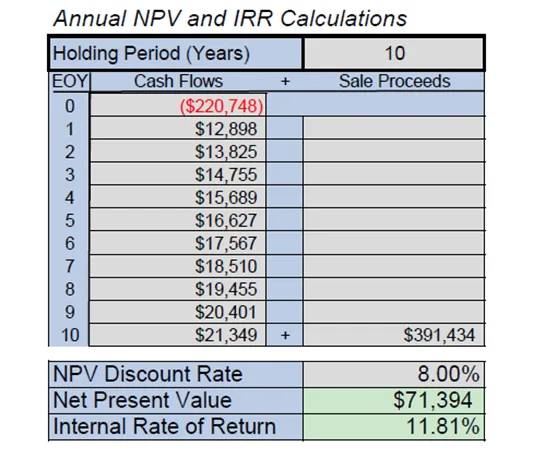
Pennsylvania Property Returns:
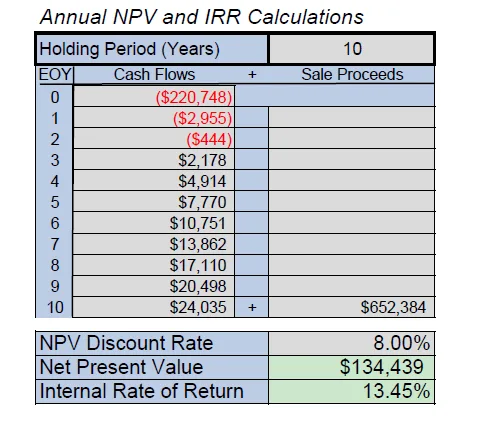
California Cash Flows
3. Understanding the Numbers
In this example, the CA property will still give you a better return because of the value of the greater appreciation. This is after taking into account the greater cash flows of the PA property.
Net Present Value (NPV) in real estate calculates the difference between the present value of cash inflows and outflows over a specific period, discounted at a target rate. It determines the profitability of an investment by expressing future income in today’s dollars, where a positive NPV indicates expected returns exceed the cost of capital.
- Here, the NPV shows the cash return in an amount in excess of the 8% target return. In other words, if you took this cash and parked it in the stock market earning a 8% return, the NPV would be 0, which indicates it returned exactly a 8% return. The $71,394 that the PA return is the additional amount this cash flow made while being in this investment, and $134,439 is the additional return above 8% that the CA property generated.
- The net difference between the return of the two properties is: CA return of $134,439- PA return $71,394= $63,045 Net difference in overall return.
You may think in looking at the future appreciation value of the CA property, which is $652,384, that it would be a greater return than the PA exit growth of $391,434.
However, the time value of money makes this spread much less, as the cash flows of PA property would give the ability to increase your returns with the money you get sooner, and reinvest.
- In the above example we assume that the California Property will have rent growth of 4%, while the Pennsylvania will have 2% rent growth.
- Because California has a higher population growth rate, which is forecasted at 1.20% per year, a higher rent growth rate may be reasonable.
- Dauphin County Harrisburg population growth rate is .37% annual growth, (According to Site to do Business) and historically has had a rent growth rate between 2-3%.
Final Thoughts
But what if the folks who move to CA decide the Summers are too hot, or they can’t handle the threat of fires and earthquakes? That population growth may drop off…..leaving you better off in a steady market like Central PA.
That’s why investing where and what you know is often the best option. Now what was that first rule of real estate again?
That’s right…..
If you want to discuss Location, Location, Location for Pennsylvania investments, CONTACT us to discuss the best path forward for growing your NOI.