
Huge recession coming.
A tide of inflation is coming again.
As opposite as night and day.
Every day I talk to investors, and what I hear sounds like investor sentiment is equally divided between those who think the sky will soon fall, and other who are waiting for inflation to drive up their real estate even more than their stock portfolio.
This had me thinking about the indicators that we can look for to understand where the waves of our economy are pulling.
The M2 money supply is one such indicator.
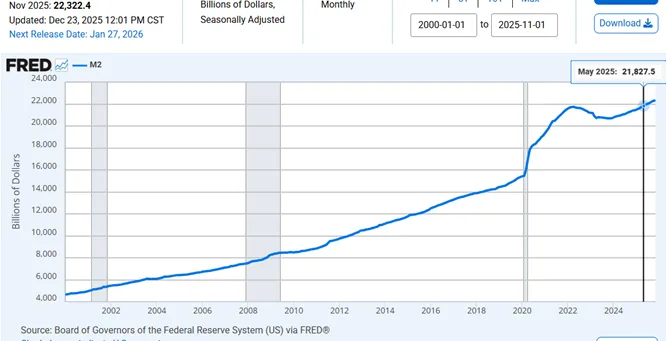
Straight from the stats of the Federal Reserve Bank of St Louis, this graph shows the M2 money supply and how it has changed (Increased) since 2000.
In 2000 it was $4.680.9 Billion
In 2025 $22.322.4 Billion
By my simple math that is a 4.76x increase in the past 25 years.
In contrast, the US population grew by 17% over the same 25 year period.
So if our money supply has increased almost 5X in the past 25 years, what does this mean for our future monetary value?
What is M2 Money Supply (In Plain English)?
If you are like me, maybe you didn’t get an MBA in finance, and needed to brush up on what M2 supply is.
‘M2 is a broad measure of how much money is available in the economy and ready to be spent or invested.’
It includes:
- Physical cash and coins
- Checking account balances
- Savings accounts
- Money market funds
- Small time deposits (like CDs)
Think of M2 as money that can move. It’s not locked away in long-term instruments or obscure balance sheets—it’s money that households, businesses, and investors can deploy fairly quickly.
How M2 Actually Grows (or Shrinks)
M2 doesn’t grow by accident. It expands and contracts primarily through monetary policy and banking activity.
1. Central Bank Policy
When the Federal Reserve lowers interest rates or buys assets (like Treasury bonds), it injects liquidity into the banking system. Banks suddenly have more capacity—and incentive—to lend.
- Within the last 5 years, the Fed has increased its balance sheet dramatically as it pushed more money into our system. No surprise, we had dramatic inflation.
2. Bank Lending
Every time a bank makes a loan, new money is effectively created. That mortgage, construction loan, or credit line didn’t exist before—it does now.
3. Government Spending
Deficit spending puts money directly into the economy. Stimulus checks, infrastructure spending, and subsidies all increase M2.
When rates rise, lending slows, and government spending tightens (because of increase debt payments), M2 growth stalls—or even reverses.
Bottom line: M2 expands when borrowing is easy and contracts when borrowing becomes expensive.
A note on AI:
It was interesting to note as I researched, that there were several periods of time where the money supply increased, but inflation remained low. This was during the 1880’s when great advancements were made like the lightbulb, Combustion engine and electrification.
In a similar vein, in the 1990’s as the internet gained prominence and transformed our world, a deflationary period in wages followed.
Could an AI revolution lead to similar increase in productivity, making our lives wealthier (with more money) but not spark inflation, because of the downward pressure on wages it would create?
Why Investors Should Care About M2
Real estate is a capital‑intensive asset class. It thrives when money is plentiful and struggles when liquidity dries up.
Historically, periods of strong M2 growth have aligned with:
- Rising asset prices
- Easier refinancing
- Cap rate compression
- Increased transaction volume
Periods of flat or declining M2 tend to bring:
- Higher cap rates
- Slower deal flow
- Price discovery and volatility
- Distress among over‑levered owners
You can track the Monetary supply through the Fed’s website: https://fred.stlouisfed.org/series/M2SL
How M2 Filters Into Real Estate Markets
M2 doesn’t flow evenly across the economy. It tends to hit financial assets first, then move outward.
Typical progression:
- Stocks and bonds reprice
- Institutional real estate absorbs capital
- Private real estate follows
- Rents and property values adjust
That’s why real estate cycles often lag financial markets—but once capital arrives, pricing can move quickly.
For commercial real estate specifically:
- Multifamily benefits early due to income stability
- Industrial follows via business expansion
- Retail responds as consumer spending rises
- Office is usually last and most sensitive to tightening
Conclusion
The Federal Reserve is again putting liquidity into the market (AKA Qualitative easing) this may continue to drive inflation in the coming year.
The only caveat is: if AI is the next ‘internet’ or ‘lightbulb’ and does create huge productivity gains, we may see another unusual shift in the economy. Hold on, it will be an interesting year.
Many clients we work with are forward thinking and benefit from our resources to think outside the box and understand the dynamics around our economy.
If you are looking to make portfolio moves in the coming year, contact us to schedule a strategy session. These are limited to one per week, so get on the schedule by contacting us today.
To your success in 2026!
Video
Sources
https://courses.lumenlearning.com/wm-macroeconomics/chapter/measuring-money-currency-m1-and-m2/
https://advisor.visualcapitalist.com/chart-money-supply-and-inflation-over-150-years
Disclaimer:
Our opinions are our own, and each investor should do their own research about what they believe will happen in the economy. We do not represent that we are finance professionals, and are only offering our view from the Commercial Real Estate Market.