
For Multifamily owners, opening their property insurance bills be like: time to take out a second mortgage!
For owners all over the country, higher property insurance is an issue that continues to escalate, with factors like increased liability claims, rising property damage claims and natural disasters all coming together to increase the cost of coverage that owners can’t be without.
One of the most effective – but often overlooked – levers an owner can pull is requiring tenant insurance and structuring it so the tenant, not the owner, bears the premium. A fully insured tenant base reduces claim frequency on the owner’s master policy, shifts liability for tenant-caused damage off the owner’s loss runs, and gives the underwriter a measurable reason to keep the renewal flat – or reduce it.
There are two proven ways to put this in place: a reimbursement model administered by the owner, and a direct-purchase model in which the tenant carries their own policy. Both protect the asset; the right choice depends on property type and operational capacity.
Why Tenant Insurance Lowers the Owner’s Premium
Insurance Companies price property insurance largely on loss history.
- Every small claim – an overflowed bathtub, a kitchen fire, stolen contents – ends up on the owner’s loss runs when the tenant has no coverage.
- After two or three of those events, the property gets repriced as higher-risk, deductibles climb, and some carriers walk away.
- A 100% insured tenant base flips the math: subrogation works against the tenant’s carrier, smaller losses never reach the master policy, and many carriers now offer credits of 2% to 7% on the property premium when the owner documents tenant-insurance compliance.
Option 1: The Reimbursement Model (Master Policy)
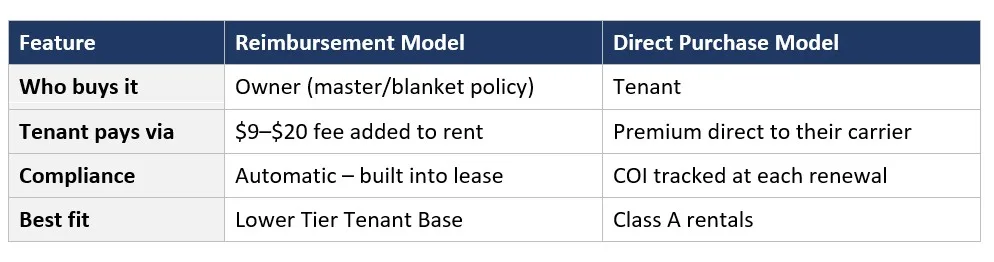
The owner purchases a master tenant liability policy – also called a Landlord Liability Insurance plicy or blanket liability program – that covers every occupied unit. The owner bills each tenant a flat fee, typically $9 to $20 per month, added to the rent invoice. The fee covers the master premium plus a small administrative margin.
- Coverage: $100,000 tenant legal liability is standard. Coverage for TENANT caused property damages is also included. This coverage always names the Landlord as additional insurance for liability issues.
- Lease language: Mandatory participation, with opt-out only if the tenant provides a COI for comparable direct coverage.
- Billing: Line item on the rent statement – collection is automatic.
- Why owners like it: 100% compliance from day one, predictable ancillary revenue, and a single binder to show at renewal instead of thousands of certificates.
- What it doesn’t cover: Often these policies do not cover Tenant’s personal property damage, but a rider can often be added to blend this in, if the Landlord would like to provide that coverage to a tenant as a benefit.
The goal of these policies is to offset the liability and property damage caused by tenant, and pass this cost on to the tenant’s line item. For this goal the master policy is very effective at this.
Option 2: The Direct-Purchase Model (Tenant Buys Their Own)
A rental lease requires each tenant to obtain and maintain their own renter’s policy from a licensed carrier, with the owner named as additional insured and certificate holder. The tenant pays the carrier directly; the owner verifies coverage through a certificate of insurance at signing and every renewal.
- Minimum limits: $100,000 liability for residential, property damage AND tenant property coverage.
- Additional insured: The single most important clause – it gives the owner direct access to the tenant’s policy in a covered loss.
- COI tracking: Collected at move-in and each renewal; services like Jetty, Assurant CoverCheck, and MSI ePremium automate the chase.
- Why owners like it: Zero premium dollars on the owner, broader coverage available to the tenant.
The direct purchase model is very effective coverage for BOTH the Landlord and the tenant. A renter’s insurance policy provides more coverage for the tenant, and for higher net worth tenants is a worthwhile investment.
Side-by-Side Comparison
Implementation Tips for Owners
- Write it into the lease, not the addendum, as a primary covenant – not a checkbox.
- Set a clear remedy for non-compliance: force-placed coverage at the tenant’s cost plus an administrative fee.
- Bring proof to your Insurance Company: document the lease clause, the master binder or COI tracking process, and your compliance rate – then ask for the credit.
The Bottom Line
Tenant insurance is one of the few risk-management tools that simultaneously lowers the owner’s property insurance premium, reduces loss-run claim frequency, and either generates ancillary income or shifts cost off the balance sheet entirely.
Multifamily owners who make sure to implement coverage will have lower premiums- and more importantly- lower cost and liability exposure for the long term.
Many Multifamily owners we work with have implemented important strategies like Tenant level coverage to help protect and grow their assets for long term freedom. If you are looking for the next tier of growth with your investments, reach out to us today to discuss your long term growth.