
The dreaded call no investor wants after a big storm- your roof is leaking!
Being an investor myself, I have received this call multiple times. I’ve had buildings with shingle roofs, metal roofs and flat rubber roofs.
If you are like me, you started investing without knowing a ton about roofs, but quickly realized how important the questions about roof condition can be when looking at a building to buy, or when evaluating a roof replacement on an investment.
With insurance costs these days, making sure your roof is solid is also a major concern for your insurance company, which means it is your concern too when the premiums come calling on your wallet.
A roof replacement on a large multifamily property can run into six figures, and the type of system installed drives not just replacement cost, but insurability, energy expense, maintenance burden, and how long it lasts before replacement.
Below is a rundown of the roofing systems you’ll encounter most often, what they cost to own over time, and how long each one realistically lasts.
1. Asphalt Shingles
The default choice on pitched roofs — garden-style communities, townhome-style multifamily, and smaller walk-ups. Available in 3-tab or architectural (dimensional) grades.
Pros:
- Widely available materials and labor keep repair costs low and turnaround fast.
- Performs well on steep-slope designs; familiar to insurers and lenders.
Cons:
- Shorter lifespan than commercial systems, and 3-tab grades weather faster.
- Vulnerable to wind and hail — can affect insurability in storm-prone markets.
Lifespan: 15–20 years (3-tab); 25–30 years (architectural/dimensional)
Flat Rubber Roofing:
The term “rubber roof” is a general category that can include synthetic materials designed for flat roofs, including the below categories.
2. EPDM
A single-ply synthetic rubber membrane and the long-standing workhorse of flat and low-slope roofs on mid-rise and high-rise apartment buildings.
Pros:
- Lowest-cost flat-roof option with a decades-long performance track record.
- Flexible in cold climates and easy to patch when punctured.
Cons:
- Black surface absorbs heat, driving up top-floor cooling costs.
- Seams (glued or taped) are the most common failure point if not properly installed.
Lifespan: 20–25 years, up to 30 with diligent maintenance
3. TPO — Thermoplastic Polyolefin
Now the most commonly installed flat commercial roof in the U.S. A white, reflective single-ply membrane with heat-welded (not glued) seams. Made from a blend of rubber and polypropylene, large rolls of this material are laid out and heat-welded together at the seams to form a highly durable, watertight, and energy-efficient barrier.
Pros:
- Reflective surface cuts cooling costs versus EPDM; heat-welded seams are inherently stronger than adhered ones.
- Cost-competitive with EPDM while offering better energy performance.
Cons:
- Quality varies significantly by manufacturer and installer — not all TPO is created equal.
- Newer product category, so real-world 30-year data is thinner than EPDM’s.
Lifespan: 15–25 years, heavily dependent on installation quality
4. PVC Roofing
A premium single-ply membrane, chemically similar to TPO but formulated for greater durability and resistance to grease, chemicals, and fire — common where rooftop restaurant or HVAC exhaust is present.
Pros:
- Most durable of the single-ply membranes; strong heat-welded seams; fire and chemical resistant.
- Reflective, helping offset cooling costs like TPO.
Cons:
- Highest material cost among single-ply systems.
Lifespan: 20–30 years
5. Modified Bitumen
An asphalt-based roll roofing reinforced with fiberglass or polyester, installed torch-down, self-adhered, or hot-mopped. Common on older flat-roof apartment stock.
Pros:
- Inexpensive, holds up well under foot traffic, and performs reliably in cold climates.
- Straightforward to patch and repair.
Cons:
- Torch-down installation carries fire risk; less energy-efficient than white membranes.
Lifespan: 15–20 years
6. Built-Up Roofing (Tar & Gravel)
The legacy flat-roof system: alternating layers of asphalt and reinforcing fabric, topped with a gravel ballast. Still common on pre-1990s multifamily buildings.
Pros:
- Multiple layers provide redundancy; the gravel cap offers strong UV and puncture protection.
- Proven long-term durability when maintained.
Cons:
- Heavy — verify structural capacity
- Leaks are hard to locate under the gravel
This type of roofing is largely being phased out, but investors may find it on older buildings.
Lifespan: 15–30 years
7. Metal Roofing
Standing seam or corrugated panels, typically used on pitched roofs or as accent/mansard elements. The longest-lived option by a wide margin.
The most common metals used for roofing are steel and aluminum. Steel is the most prevalent, typically treated with galvanized (zinc) or Galvalume (aluminum-zinc) coatings to prevent rust. Aluminum is lightweight and rust-resistant, but lighter than steel and more prone to denting.
Pros:
- 40–70-year lifespan means it can outlast your entire hold period, often with no replacement capex at all.
- Fire-resistant, low-maintenance, and reflective coatings reduce cooling load.
Cons:
- Highest upfront cost; hail can dent panels; requires specialized installers.
Lifespan: 40–70 years
At a Glance
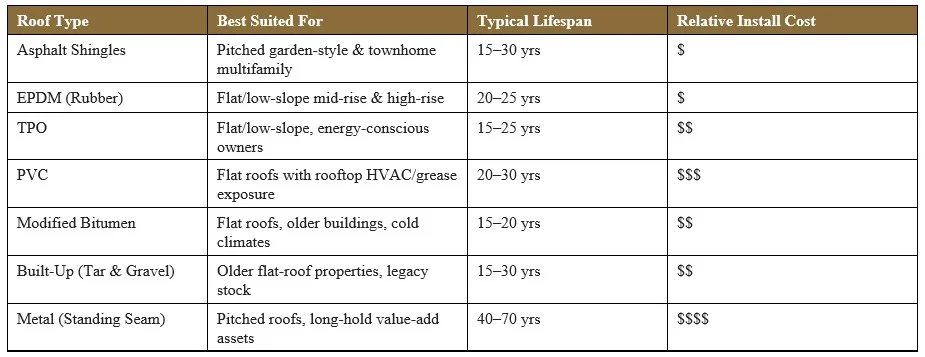
Underwriting Takeaways for Acquisitions
When evaluating a building for purchase, keep these best practices in place.
- Always pull the roof’s install date and, if available, a roofing certification or inspection report during due diligence — age matters more than the seller’s word.
- Roof type and condition directly affect insurability and premiums, especially in wind- and hail-exposed markets.
- On longer-hold value-add deals, metal’s upfront premium can pencil out by eliminating a roof replacement entirely during your hold.
- Confirm warranty transferability at closing — many manufacturer or installer warranties- especially on TPO and PVC systems- can be assigned to a new owner if requested before transfer.
Over It All
As an investor, making a roof decision is a crucial part of Capital Expenses, and ensuring it is part of your underwriting when purchasing will protect your overall return.
Being proactive and knowledgeable on your roof condition means you can avoid those unwanted ‘roof leaking’ calls that no investor wants to receive.
Stay dry, my friends.
We help investors make informed decisions to ensure they meet their profitability goals for investing. CONTACT US today to discuss your next sale or purchase.